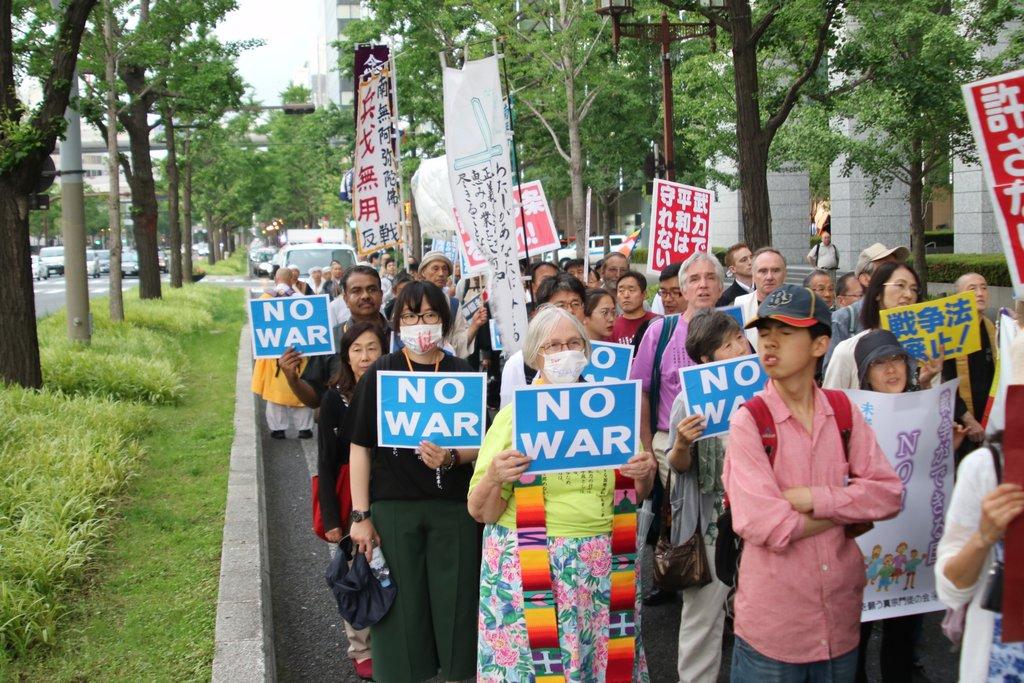
Peace prevails where everyone has fair and equal access to justice and an atmosphere to live in security. Peace sustains only in a situation where everyone is able to participate in shaping their destiny and decision makers are accountable to the people. Peace is, therefore, a state of order, of freedom from fear and want, of being secure. In such a society as Prophet Micah says, “Everyone will sit under their own vine and under their own fig tree, and no one will make them afraid” (Micah 4:4).
On the contrary, it is a matter of serious concern today that we are forced to live in situations where peace is threatened and justice is denied. The greed of powerful nations and individuals exclude others, concentrate only in accumulation of wealth and exploitation of resources, leaving others dispossessed and impoverished. The domination of the rich and the powerful causes discord and adds deprivation. All these factors increase domination, marginalization, violence, conflicts, wars, poverty and sufferings in human life. It is not God’s will that is fulfilled in such a situation, but it contradicts the purposes of God’s ways of living together in the household of God. The living together in the household of God with a collaborative, mutually recognized and respected atmosphere will make the household a place where peace with justice and security prevail. Such a situation requires a radical reversal of the existing systems and conditions, to a context in which “justice will roll down like waters and righteousness like an ever flowing stream” (Amos 5:24). Peace is basically a gift of God, and is related to God’s blessing and God’s graciousness.
Building Peace with Justice: Challenges to Churches in Asia
The absence of peace in the Asian context is to be understood not merely in the contexts of violence and civil wars only. Denial of the basic socio-economic and cultural rights to a vast number of people basically leads to a situation where peace is negated and justice is denied. The end of the Cold War, the growing impacts of globalization and rapid economic growth are making several Asian countries to reposition and redefine their roles both at the regional and at the global levels. While the pivot of international politics is shifting towards the Asia region, the new century also poses several challenges to peace and security in Asia. There are many factors and key stakeholders from within the region as well as outside of the region responsible for threatening peace in Asia and intensifying conflicts. When we agree that civil war and conflicts have already ended in several contexts in Asia, it is also increasingly evident that threat to peace and security at different levels continues to be a pervasive phenomenon in several Asian countries.
Asia today faces an ever increasing level of multifaceted social, economic, political and security challenges. A wide array of problems is precipitating in Asian societies, causing threat to peace and denial of justice. Armed conflicts and violence, increasing poverty, inadequate health care, economic exploitation, environmental degradation and exploitation of natural resources, militarization, arms build-up, nuclearisation, spread of small arms and light weapons, domination and intervention of major powers from outside the region as well as within the region; ethnic and religious conflicts, communal violence, and political unrest; torture, custodial death, suppression of people’s legitimate right to self-determination; lack of rule of law and democratic governance are part of a series of issues affecting Asia’s peace and security.
It is in this context that the Asian churches are called to be peace makers and to be courageous, committed and consistent in their efforts in order to be credible voices in the household of God. Churches are also called to be instruments of God’s purpose in the world, which calls them to take concrete action in peace-building in order to move beyond conflicts. The ecumenical movement itself emanated from the need to be in peace and unity not only within the church, but with the community of people who belong to other faiths. Christian Conference of Asia has been instrumental in nurturing a culture of peace in Asia through various activities ever since it’s founding. Peace with justice and human security continues to be a major concern of the CCA and the following areas will be of special foci of CCA’s mission and witness in this area in the next five years:
- Towards Peace with Justice and Human Security
- Accompanying Churches and Communities in Conflict Situations
- Churches in Action for Moving Beyond Conflicts and Reconciliation
- Churches’ Response to Militarization, Nuclearization and Arms Race in Asia
- Peace Building Training for Church Workers
- Ecumenical Women’s Action Against Violence ( EWAAV)
- Young Asian Ambassadors of Peace in Asia ( YAAPA)
- Eco-Justice for Sustainable Peace in the Oikos